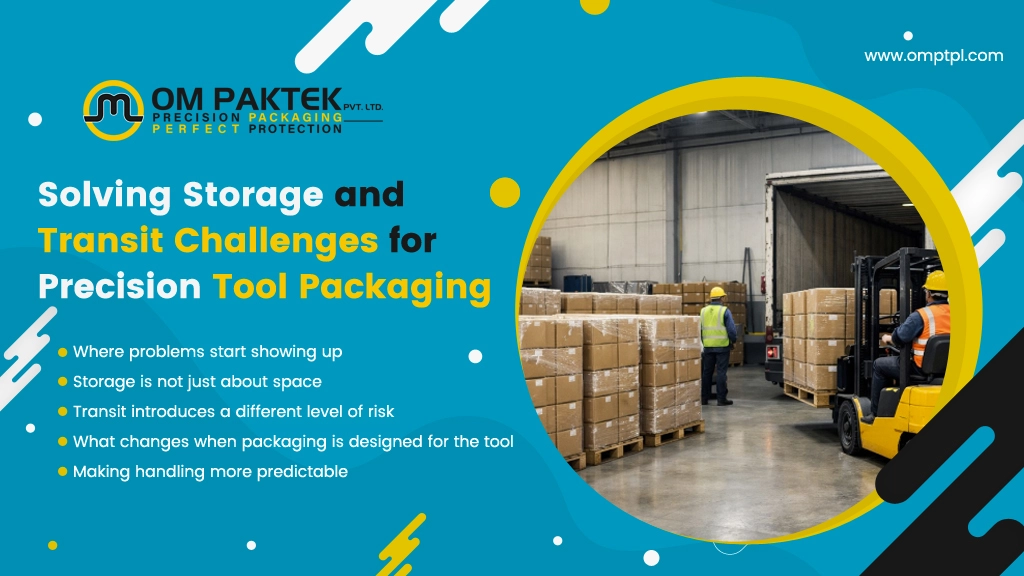
Solving Storage and Transit Challenges for Precision Tool Packaging
In precision tool manufacturing, the focus is often on performance — cutting accuracy, durability, and consistency in output. Every tool is designed and produced with a clear purpose, and a significant amount of effort goes into achieving that level of precision.
But once the tool is ready, a different set of challenges begins.
Not in manufacturing — but in how the tool is stored, handled, and moved.
This is especially critical in precision tool packaging, where even small handling issues can impact performance.
Where problems start showing up
Tools rarely stay in one place.
They move between machining, inspection, storage, assembly, and eventually transit. In many cases, they are handled multiple times before reaching their final use.
And in this movement, issues begin to appear.
- tools coming into contact with each other
- edges getting damaged during storage
- inconsistent placement leading to handling errors
- difficulty in identifying or accessing the right tool quickly
These are not major failures — but they are frequent.
And over time, they affect both tool life and operational efficiency, especially in day-to-day tool handling and storage.
Storage is not just about space
In many setups, storage is approached from a space perspective — how many tools can be stored, how efficiently racks or bins can be arranged.
But for precision tools, storage is not just about holding quantity.
It is about how each tool sits.
A tool placed without defined support points can shift.
A surface left exposed can get affected.
A layout without structure can lead to inconsistent handling.
This is where tool storage systems and well-designed tool packaging solutions start making a difference in maintaining order and consistency.
Transit introduces a different level of risk
If storage is about stability, transit is about movement.
During transit — whether internal or external — tools are exposed to:
- vibration
- impact
- shifting within packaging
- repeated loading and unloading
Without controlled positioning, even well-manufactured tools can face avoidable damage.
This is where transit packaging solutions and protective packaging for tools become important in reducing risk during movement.
What changes when packaging is designed for the tool
A different approach begins when packaging is designed specifically for the tool and how it is used.
Instead of treating all tools the same, the focus shifts to:
- how the tool should be supported
- which areas must remain untouched
- how movement can be restricted
- how handling can be made consistent
Structured cavities hold tools in place.
Defined spacing prevents contact.
Orientation ensures correct placement every time.
These decisions directly improve packaging for tool safety in real manufacturing environments.
Making handling more predictable
One of the biggest advantages of well-designed packaging is not just protection — it is predictability.
When tools have a defined place and orientation:
- operators handle them more consistently
- time spent searching or adjusting reduces
- chances of incorrect placement drop
This brings a level of control into everyday operations without adding complexity.
In real manufacturing environments, storage and transit are not separate from production — they are part of the same flow.
When packaging does not align with this flow, small inefficiencies continue to build over time.
At OM Paktek, this is taken into account while developing solutions — by understanding the tool, how it is handled, and the conditions it goes through during storage and movement. The aim is to ensure that packaging matches the way tools are actually used on the shopfloor.
In the end, tools designed for precision
need to be handled with the same level of control — even beyond manufacturing.