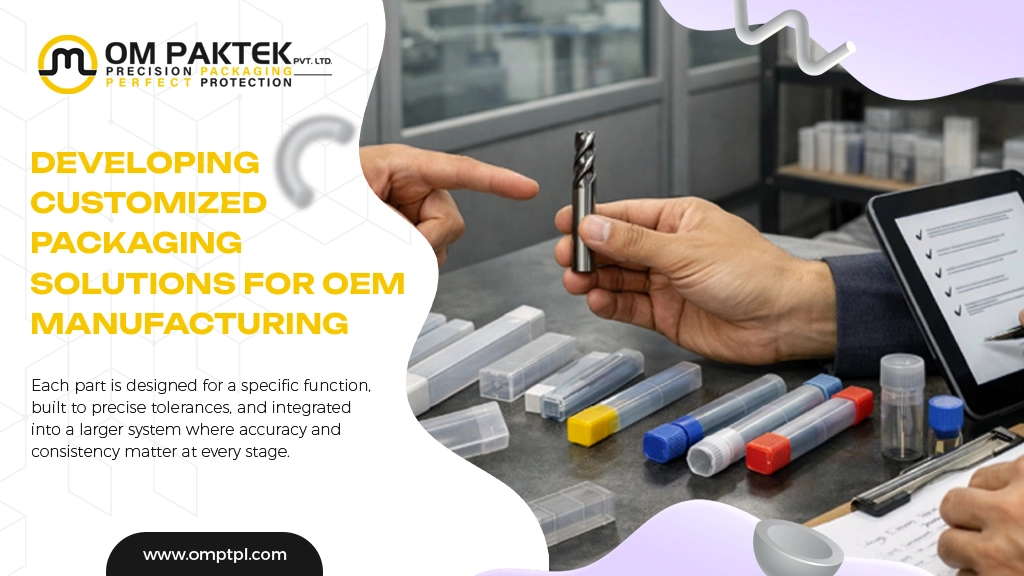
Developing Customized Packaging Solutions for OEM Manufacturing
In OEM manufacturing, no two components are truly the same.
Each part is designed for a specific function, built to precise tolerances, and integrated into a larger system where accuracy and consistency matter at every stage. From machining to assembly, every process is carefully controlled.
But when it comes to packaging, this level of precision is not always carried forward.
This is where the need for customized packaging for OEM manufacturing becomes clear.
If manufacturing is customized… why is packaging still standard?
In many cases, packaging is approached as a common solution — something that can work across different components with minimal adjustment.
But OEM environments don’t operate on standardization alone.
Components vary in shape, weight, surface sensitivity, and handling requirements. Some need isolation, some require firm support, and others demand controlled orientation. When packaging does not reflect these differences, it creates gaps in handling, storage, and movement.
And those gaps often show up as:
- inconsistent handling across operators
- avoidable surface damage or wear
- inefficiencies during storage and internal movement
Over time, these small issues begin to affect overall workflow.
This is where better OEM packaging solutions become necessary.
Where customization actually begins
Customization in packaging is not just about changing dimensions or creating a different layout.
It starts with understanding the component and the environment in which it operates.
How is the part handled on the shopfloor?
How often is it moved?
Where are the sensitive areas?
What kind of support does it require?
These questions define the design.
This is where component-specific packaging and custom industrial packaging design begin to take shape, based on actual requirements rather than assumptions.
Designing for real manufacturing conditions
In OEM manufacturing, packaging does more than just hold a component.
It moves with the process.
It affects how quickly a part can be picked and placed.
It influences how safely components are stored.
It determines how consistently parts move between stages.
This is where thoughtful design makes a difference.
- Structured cavities help maintain position and reduce movement
- Defined support points prevent unwanted contact
- Orientation-based layouts guide correct handling
- Stackable designs improve space utilization without compromising safety
Individually, these may seem like small decisions. But together, they contribute to better packaging for production efficiency and reduce variability across operations.
This is also where engineered packaging solutions come into play — built around real manufacturing conditions.
When packaging becomes part of the workflow
The real value of customized packaging is not just in protection — it is in how naturally it fits into the manufacturing process.
When designed correctly, packaging reduces dependency on careful handling alone. It creates a system where the component is naturally placed, supported, and moved in the right way.
This reduces variability.
And in OEM manufacturing, reducing variability is as important as maintaining precision.
In OEM environments, packaging does not exist separately from the process — it moves with it.
It is part of how components are handled, stored, and transferred from one stage to the next. And when that packaging is not aligned with the way the component is actually used, small inefficiencies begin to show up over time.
This is why customization becomes necessary.
Not as an added feature, but as something that fits into the way manufacturing already works.
At OM Paktek, this is reflected in how solutions are developed — by understanding the component, its application, and the conditions in which it is handled on the shopfloor. The focus remains on ensuring that packaging matches the way components are handled every day.